Friday, 4 July 2014

Happy Independence Day!

To celebrate our favourite American Holiday, here's a visual feast of the works
of my favourite American Architect, the one & only Frank Lloyd Wright!


http://www.fallingwater.org/


http://www.guggenheim.org/


http://www.greatbuildings.com/buildings/Rosenbaum_House.html


http://en.wikipedia.org/wiki/File:Robie_House_HABS1.jpg


http://www.peterbeers.net/interests/flw_rt/Missouri/Kraus/Kraus.htm


http://en.wikipedia.org/wiki/Imperial_Hotel,_Tokyo


http://www.theschwartzhouse.com/Photos.html#19

See & learn more at http://www.franklloydwright.org/

Friday Doodle - Name that Building

I like to doodle random little things, so for some Friday amusement here's a little Architecture Doodle: can you guess the building he represents? 

Thursday, 3 July 2014

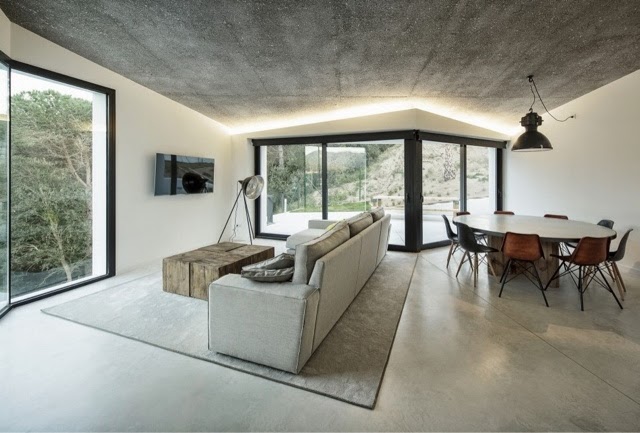
Archi Dream House - House in LLavaneres

Residential Architecture has a certain allure; it’s a highly intimate & personal architecture and it’s small(ish) scale gives a real freedom to explore your creativity in a way that often just isn’t possible in large scale buildings.

For me, I’m uncertain where my style preference is in residential architecture, I like the sleek crisp look of modernity but I prefer traditional/natural materials (huge fan of stone). I loathe the clutter & fussy-ness of more traditional styles (country cottages fill me with an unfathomable dread) yet, I find the stark, minimal nature of contemporary too clinical.


So naturally I was surprised when I found myself so fond of a little white concrete haven in LLavaneres, Barcelona. 


Designed by MIRAG ArquitecturaiGestió, the polyhedral household explores and celebrates the delights to be found in split level architecture (a site with a 30% slope in this instance). The obscure shaping leads to a series of wonderfully weird angular openings, each one framing a rather spectacular view to the beautiful surroundings.

The upper (street) level as you would expect is where the main activities of the house are found while the lower level offers two additional spaces that link out to the garden and a rather enviable pool.


Within the space itself there is a starkness that is strangely appealing to me, where I would usually feel clinical I find the space feels calm. The house feels light as though it could easily float away. 


The exposed concrete surfaces are complimented with a muted colour scheme (its all greys & browns), which might just be why it works. Instead of gazing at an ultra-modern-retro bright red sofa in a big empty space, I’m looking past the silent furnishings to the outside & those incredible views, the large glazed openings tempting the visitor outside into the sunshine.


In contrast the exterior’s brilliant white surface shines, rather than hide itself within the land, it jumps out to draw you toward it, it wants you to know (without being garish or overbearing) that this land is it’s home & in this home you’ll get the best views for miles around.


(All images from ArchDailywww.archdaily.com/520809/house-in-llavaneres-mirag-arquitecturaigestio)


Wednesday, 2 July 2014

Archicraic in Edinburgh: Craighouse Asylum

"They told me this was a very nice place to live at...You may imagine my
horror when I found it was a lunatic house..."
James L
(http://www.scotsman.com/lifestyle/letters-tell-of-life-inside-victorian
-mental-asylum-1-2811775)

Hidden within Edinburgh's southern boundaries is the architectural gem
known as Craighouse. The site has a varied history, playing host to
Architects Robert Reid, William Burn Edinburgh Lunatic Asylum (later
called the Royal Edinburgh Hospital for Mental and Nervous Disorders) in
the late 1800's & more recently a Napier University Campus. 
As you would expect from a former Victorian hospital, this site is
abundant in breathtaking Victorian Architecture (& also one rather
unfortunate later edition that rings of 1960's brutality). 
http://canmore.rcahms.gov.uk/en/site/73627/details/edinburgh+craighouse+
road+new+craig+house/

My first interaction with the site was on a walk, I had no idea it was
there until my attention was caught with tantalising glimpses of
Sandstone amidst the trees or the surrounding woodland. Then I turned a
corner in the path to find myself standing in an open space dominated by
the wonders of yesteryears. 
My first reaction is that you can immediately feel the history in the
site (the hospital more than the university). I was first confronted by
the site's largest building, the main hospital block. Standing before it
as minor speck in it's shadow, you can instantly feel the sinister
atmosphere around it. It's once spotless sandstone exterior blackened
with age adding to the uncomforted thoughts of what happened within its
imposing walls. 
But then as you drift back in to today, you are left gazing upon the
abandoned wonder, realising that those walls that no doubt the mere
sight of once struck fear in it's visitors (both willing & non), now
stands a space haunted by the loss of it's importance (a frightening
irony considering much of the same would have been inflicted upon its
former inhabitants). 
http://canmore.rcahms.gov.uk/en/site/73627/details/edinburgh+craighouse+
road+new+craig+house/

To me nothing is sadder than a beautiful building neglected or
suffering, throughout history legacy was important, we needed something
to pass on to our future generations. So with this ethic Architecture of
the past was built to last, and in our modern throwaway world we've let
too many good things suffer & die in plain site. 
http://www.geograph.org.uk/photo/2009657

And this is where the story almost had a happy ending...
Craighouse was recently sold to the Mountgrange Real Estate Opportunity
fund/Craighouse partnership, a development company with plans for
transforming the site into a residential redevelopment. This is no real
surprise or reason to panic really as this the general fate of historic
buildings and I would rather see historic architecture used than let to
rot. But upon hearing the development plans the joy very much ends
there... 
Putting aside the frightening lack of knowledge the developer has
displayed about the sites current state (initial site plans show the
buildings with some rather fantastical dimensions & an array of phantom
trees), it is the Craighouse Partnerships proposition of the insertion
of some new builds to "compliment" the context that have proven cause
for alarm. 
Should the plans go ahead no longer would I find my focus drawn to the
historic beauty of the site instead, I would find myself visually
assaulted by titanic sized bundles of "luxury modernity" spreading
across the wondrous open green space the site offers. 
www.friendsofcraighouse.com/

Here the greed of developers here becomes as evident as the garishness
of their proposed new builds, instead of investing all the money into
the existing buildings redevelopment (there is the potential for a large
number of flats/apartments here) they have chosen quantity over quality.
It's a saddening reality as we don't need more cheapened "trend"
residential architecture, the sites current buildings (minus 1) prove
that quality is what stands the test of time & can go on to be reused
over & over, building a rich & vibrant history along the way.

All is not yet lost though, The Friends of Craighouse are fighting the
good battle to preserve the site. While their reasons may be slightly
different from my own, our end goal feels the same, which makes theirs a
cause worth joining. 
For those who share this goal, if you live locally we have until 4th
July 2014 to object, so if you are local to Edinburgh you can object to
the planning authorities. Or if you just wish to help however you can
head over to www.friendsofcraighouse.com/  to find out more & how to
object
Also for some fantastic images & the original Architectural drawings for
the Royal Hospital check out
http://canmore.rcahms.gov.uk/en/site/73627/details/edinburgh+craighouse+
road+new+craig+house/

(Also for some interesting reading, give the link at the top of the page a look!) 

Friday, 23 May 2014

#SaveGsoA the loss of a loved one

Admittedly I am not an advocate for studying architecture, my memory of my studies is not something I would wish upon anyone friend or foe. Yet, despite all that I suffered from the marathon that is the Architecture course, today I realised that at the very core, architecture will always be in my heart.

At lunchtime today I was faced with the headline "firefighter battle to save Glasgow school of Art". In that very instance (& in every second after) my heart has been breaking as the iconic masterpiece is stolen from us piece by piece.

There isn't much that needs to be said to express the magnitude of this tradgedy, anyone who has ever set foot in this beautiful space will understand just how inspiring it is. I'll never forget walking its beautiful dark wooden halls filled with the creative footprints of every student who has had the pleasure of studying there. And then there is the library. It's one of the few spaces in which I've stood & felt overwhelmed by inspiration. The way the soft light falls upon its tall dark interior, you feel as though you've been immersed in a fantastical woodland worthy of the very greatest of fairytales. 

We have today however, rather tragically been pulled from our fantasy world to find ourselves faced with the horror of witnessing the architectural gem in Glasgows crown engulfed in flames & as yet we have no idea just how much can be saved.

My thoughts are with those students who not only faced not only the destruction of an icon, but also the loss of all of their own hard work. 

(Image from greatbuildings.com)


Saturday, 19 April 2014

The Architecture of Man: Our Unthinkable Possibilities

(This is a post attemp via phone, so my apologies if the format goes a little odd)

I've always been fascinated by the links between architecture & the other Arts disciplines, but there is one in particular that captures my interest & imagination above all the others.

Aerial & acrobatic arts is still a relatively new member to the UK arts scene however, this has not hindered its impact & ability to astound. 

For me, it links back to the core principles of architecture. It is an exploration of structure, form & movement, set within a predefined context (be this a piece of equipment or even another human being). 
The human structure has always fascinated me & in this realm it is explored & pushed to its very limits in the most truly inspiring of ways.
(Cirque du Soliel: image from leadingevents.com) 

This interest began some 5 years ago for me, when I began learning Aerial myself. Experiencing first hand this relationship between form & the manipulation  of a relatively 2D object into 3D, it immediately appealed to the architect in me. Just like in any design project you have your site/context (in my case my rope) & you have to interact & create a structure around it, placing one structure within another & adapting them into a feasible & aesthetic form. And just like architecture, it is critical to understand the limits of your materials & context.
(Image from aerailperformers.co.uk)

Without listing every interpretation of this very apparent link, the most interesting way to explore this is to experience it. Whether you see an aerial or acro balance performance, take a class or even simy do a "Cirque du Soliel" google search, you will almost certainly see the fundamentals of architecture in this fascinating art form. While many will tell you it is a blend of art, circus & dance for me this is most definitely Architecture 101. 
(Images from ffaentertainment.comStandard.co.uk,
Itvstudios.com & Smashingreader.com)

Thursday, 10 January 2013

Back to the Future: George Square Glasgow

As an architecture graduate, urban enthusiast & 20 minutes on the M8 short of being a Glaswegian this controversial story was bound to spark my interest.

Glasgow city council this week announced the 6 shortlisted submissions for the £15m makeover and as you might expect controversy erupted.
So the argument has become old vs new; the council want shiny, new & “look at me” factor while a large portion of Glaswegians are calling to restore the Square to its former glory.
George Square in 1867 - Sourced from https://www.facebook.com/restoregeorgesquare 

At first thought I would have agreed with the call for restoration however, upon seeing the submissions I must admit I find myself in the other camp.
I have a great enthusiasm for the design & functions of public space, and for me George Square has always failed in its principle goals.
The square is no more than a glorified roundabout, a mere garish red ash shortcut from A to B for the travelling pedestrian.

George Square Today: Sourced from Wikipedia

The restoration calls for the installation of large portions of green space & no prospect for business, my issue with this is that George Square isn’t a park, it’s a public square and public squares need to be more than just vast expanses of soggy grass.
Take for example, what is for me, Glasgow’s most successful public square: Royal Exchange Square. It’s only a few steps away from George Square & the difference in the spaces success is almost immeasurable (and there’s not a spec of green space in sight).
Royal Exchange square works because it’s integrated with the city, like most European counterparts, there are businesses (such as cafes) lining the edges offering a comfortable seat & shelter from our (frequent) bad weather. In Royal Exchange Square you can enjoy a coffee in the tranquil square, watching life go by & then carry on to the city’s shopping hub without having to traverse busy roads.

The real problem with George Square is that it’s isolated, marooned by busy roads & plighted with being hideously unattractive. I believe the new proposals offer George Square the best chance for a slice of success but only if we can overcome it’s isolation by transforming it into its own self-sufficient space, supporting Glasgow’s people by creating opportunities for more permanent small businesses to be incorporated into the space (I’d love to see a series of pavilions designed by our local architects). While I’m not sold on the idea of big patches of green space, I would like to see more landscaping; collections of trees & plantings to act a barrier between you & the unsightly roads.

      My Favourite Proposal - Design 6 (Sourced from http://www.glasgow.gov.uk/index.aspx?articleid=3411)

In short, I think we need a space where we can on a (rare) summer day; we can stop, grab a drink, sit back & admire a beautifully designed public space.

Take a look at all of the Shortlisted Proposals at http://www.glasgow.gov.uk/index.aspx?articleid=3411
Or
Join the Restoration Camp at http://www.restoregeorgesquare.com/